


Guides
Souvenir Skins: What Makes Them Different

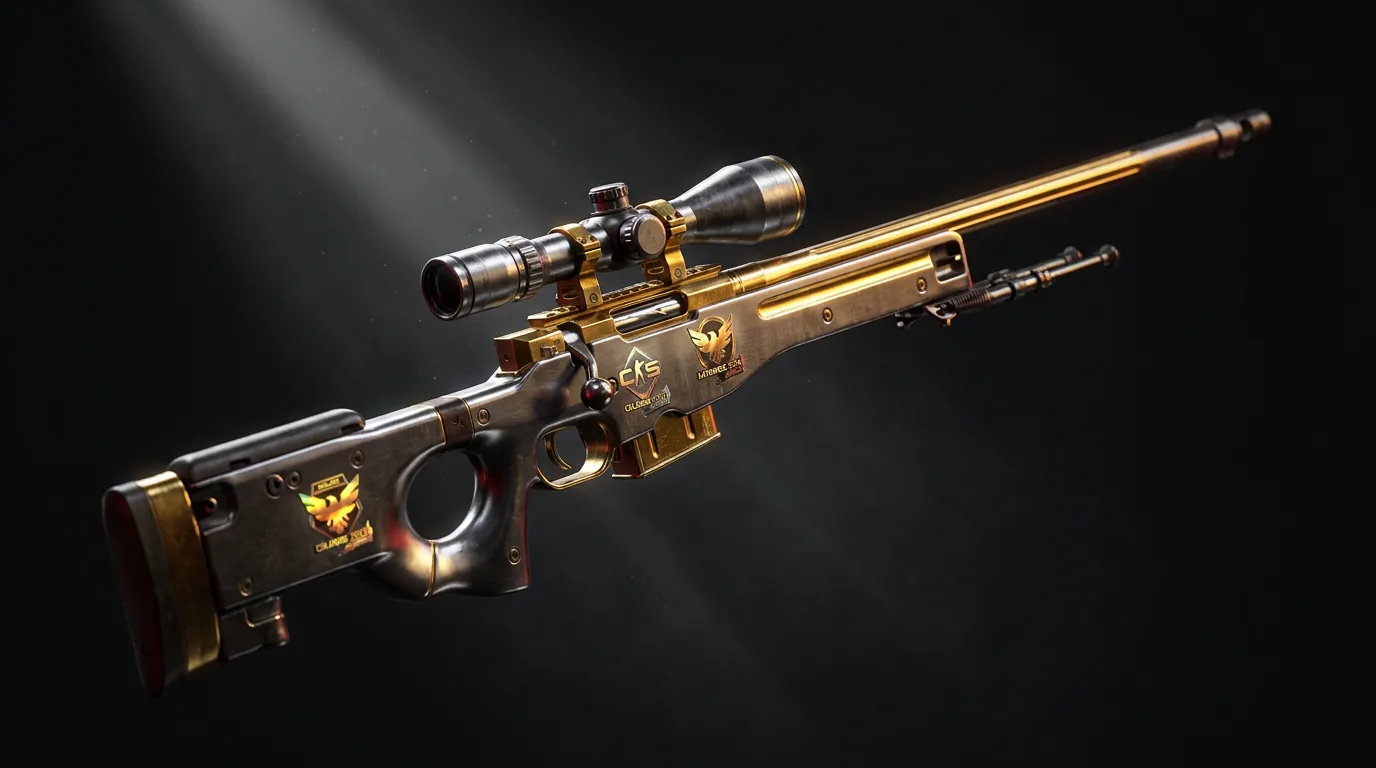
Souvenir skins are the only items in CS2 that carry a permanent record of a specific match on a specific map at a specific event. That history is welded on and can never be removed, which makes them either the most interesting items in the game or a trap for buyers who don’t read the stickers. Usually both.
What a Souvenir item actually is
A Souvenir item is a variant of an ordinary skin, marked with the Souvenir prefix and a distinct gold-yellow name colour in your inventory. Underneath, it’s the same finish with the same wear mechanics and the same rarity tier — Souvenir is a quality, layered on top of rarity, in the same way StatTrak is.
What makes it different is what comes attached. Most Souvenir items arrive with stickers already applied, commemorating the match they came from: the two teams that played, and the player who took MVP on that map. Those stickers are fixed in place. They cannot be scraped, removed or replaced, and the item can never be returned to a plain state.
The very earliest Souvenir packages, from the first events that used the system, produced items with no stickers at all. Those are a historical curiosity and behave differently in the market, but everything issued since carries the commemorative set.
Where they come from
Souvenir items never come out of weapon cases. They come out of Souvenir Packages, and packages are distributed to viewers watching professional matches — principally Majors — with a linked account. Each package is tied to one specific map of one specific match, and it draws its contents from the collection assigned to that map at that event.
That’s the structural reason Souvenir items feel unfamiliar: the collections behind them are the map-based sets, not the case sets. Those collections include the low tiers that cases skip entirely, so a large share of Souvenir drops are Consumer and Industrial Grade items worth very little. The top of a map collection — its Covert — is where the value concentrates, and the gap between the top item and everything else in the same collection is dramatic.
Souvenir, StatTrak and normal, side by side
| Normal | StatTrak | Souvenir | |
|---|---|---|---|
| Name colour | Standard | Orange prefix | Gold-yellow prefix |
| Source | Cases and collections | Cases (10% roll) | Souvenir packages |
| Kill counter | No | Yes | No |
| Pre-applied stickers | No | No | Usually — teams and MVP |
| Stickers removable | Applied ones can be scraped | Same | No, permanent |
| Usable in trade-ups | Yes | Yes, StatTrak only | No |
| Can be combined with the others | — | Not with Souvenir | Not with StatTrak |
The two exclusions matter most in practice. A Souvenir item can never be StatTrak, and Souvenir items cannot be fed into trade-up contracts at all. That second point removes a supply sink that applies to every other skin — Souvenir copies only leave circulation when accounts go dormant.
The stickers are the whole story
For any Souvenir item above the cheap tiers, the stickers frequently matter more than the skin.
Two Souvenir copies of the same finish, same wear, from the same collection, can trade at completely different levels because one came from a match involving a legendary team and carries the sticker of a player who went on to define an era, while the other came from a group-stage game nobody remembers. The skin is identical. The provenance isn’t.
Value in this dimension is driven by a few things: how significant the event was, how storied the teams on the item are, whether the MVP sticker belongs to a player with a following, and — for a small group of collectors — whether the match itself was historically notable. It’s genuinely a collectibles market, with all the emotional and reputational logic that implies, and it behaves less like the rest of the skin economy than anything else in the game.
The flip side is that stickers can reduce appeal. Sticker placement is fixed per weapon, and on some models the commemorative set lands across a prominent part of the artwork. If you’re buying a Souvenir item primarily because you want to look at the skin, check where the stickers sit before you commit — you can’t take them off.
Why the price spread is so wide
Souvenir pricing confuses newcomers because two items that look similar in a list can be orders of magnitude apart. There are four independent axes:
Which item it is. The Covert at the top of a desirable collection is the item everyone wants. Everything below it is comparatively common and cheap, and the drop-off between tiers is steeper than in case collections.
Which event. Older, more storied Majors carry more weight than recent ones, and supply from long-finished events is permanently fixed.
Which stickers. Team and player combinations do most of the work at the high end.
Wear. Souvenir items roll wear the same way any other skin does, within the finish’s own float range. Clean Souvenir copies of desirable items are genuinely scarce, because a small population is being filtered further by condition.
Stack those four and you get a market where the same skin name spans an enormous range. Never assume a price you’ve seen for “a Souvenir X” applies to the specific Souvenir X in front of you.
Fixed supply, and what that means
Once an event ends, no more packages for it are ever created. The total number of Souvenir items that can exist from that event is capped forever — bounded by however many packages dropped, minus those still sealed.
Combined with the trade-up exclusion, this produces the tightest supply picture of any item class in CS2. New copies can only appear by someone opening a package that has been sitting in an inventory for years, and that flow slows steadily over time. It’s the closest thing the game has to a genuinely finite collectible.
Unopened packages
Sealed packages are tradable items in their own right, and plenty of people hold them unopened rather than gambling on the contents. A package is a known probability distribution over a known collection from a known match — you can reason about it fairly precisely, which is more than can be said for most bets in this game.
Whether opening or holding is better depends entirely on the collection and the stickers on offer, but the important thing is to recognise that a sealed package and its expected contents are two different assets with different liquidity profiles. Packages from famous events with a desirable top item hold interest indefinitely; packages from collections nobody cares about mostly don’t.
What to check before buying
Read the stickers, not just the item name. Confirm the event, the teams and the MVP player, and understand that these are the largest single driver of value on anything above the bottom tiers.
Look at where the stickers sit on the model, because you’re stuck with them. Check the wear against the finish’s own range rather than the abstract scale. And be especially careful comparing prices — a Souvenir listing compared against a normal-quality baseline is a meaningless comparison in both directions. Souvenir versions of low-tier skins are often worth less than you’d guess, and Souvenir versions of collection Coverts with the right stickers are worth far more.
Finally, remember that the buyer pool for a specific sticker combination can be very small. High headline value and easy liquidity are not the same thing here, and on the collector end of this market they’re often opposites.
Practical takeaway
Souvenir items are gold-named variants from map collections, distributed as event packages, carrying permanent team and MVP stickers from a specific match. They can’t be StatTrak, they can’t go into trade-ups, and their stickers can’t be removed.
Value is driven by the collection’s top item, the event’s stature, the specific stickers, and wear — in roughly that order. Supply is fixed and only shrinks, which is what gives the desirable ones their long-term floor. Buy them because you want a piece of a match you care about and you’ve checked exactly what’s stuck to the weapon. Buy them as a pure flip only if you genuinely understand the sticker market, because that’s where the money actually is.