


Guides
Fade Percentages: What You Are Actually Paying For

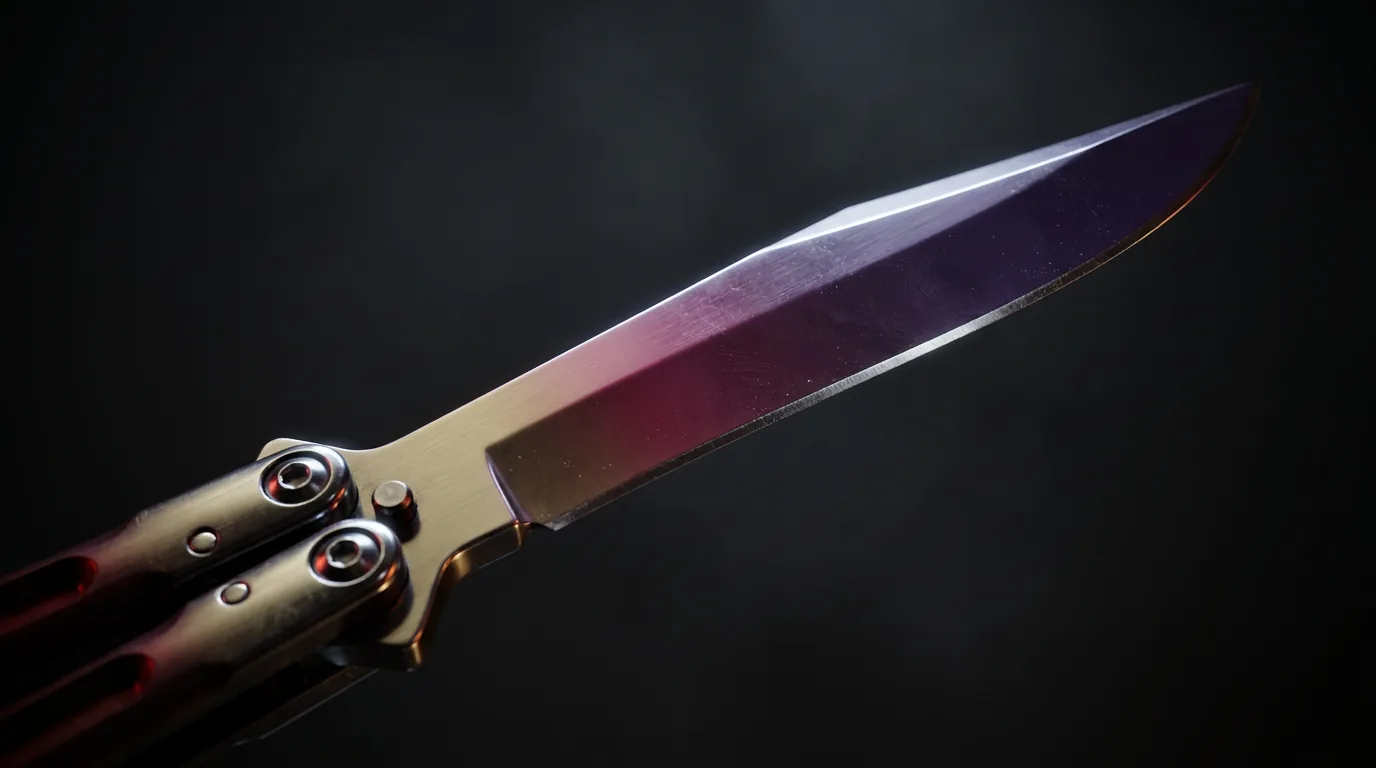
Fade is one of the few finishes where the community invented a measurement Valve never provided, agreed on it, and then started pricing items by it. The number is real and it describes something you can see. It is also routinely used to justify premiums that the eye cannot detect. Here is how the metric works and where it stops being worth paying for.
What the Fade finish is
Fade applies a continuous gradient across the model, running from a warm gold-yellow through orange and hot pink into deep violet. There is no artwork and no repeating pattern — just a colour ramp stretched over the geometry.
The item’s paint seed decides where along that ramp the visible surface sits. A low seed value pushes more of the yellow end onto the blade; a high one pushes the yellow off the model and brings more magenta and purple into view. Nothing else about the finish varies. Same colours, same order, different starting point.
Fade appears on nearly every knife in the game, on Specialist Gloves, and on a small number of weapons including the Glock-18, the Nova and the MAC-10.
Where the percentage comes from
Fade percentage is not stored on the item and is not shown anywhere in CS2. It is a value calculated from the paint seed by community tools, expressed as how far the gradient has travelled towards maximum purple coverage.
On most knives the calculated values run from roughly 80 percent at the bottom of the range up to 100 percent at the top. A 100 percent fade — usually called a full fade — is the maximum: the gradient has shifted as far as it goes, the yellow has been pushed off the visible surface, and the blade reads as pink and purple. Lower values leave progressively more gold at the base of the blade.
Because the gradient position is fully determined by the seed, every 100 percent example on a given model looks the same as every other. That is genuinely unusual in pattern trading. Full fade is a standardised product, which is a large part of why it prices at a clean step above everything below it.
Higher is usually better, but not universally
The market pays for higher percentages, and on most knives the reasoning is straightforward: buyers want the purple and consider the yellow section the weak part of the gradient.
That is a preference, not a law. A minority of collectors specifically want visible gold on the blade, because the full three-colour sweep is more dramatic than a two-colour one, and on some models the yellow section catches light better in motion. Those items are cheaper and objectively no worse-looking — they are just less fashionable.
The more useful point is about increments. The visible difference between a 100 percent fade and a 99 percent fade is essentially nil, and between a 95 and a 97 it is invisible. The steps that actually change what you see are large: full fade, high nineties, and then the broad middle of the range. Paying a steep premium to move a single percentage point below 100 is paying for a number rather than an appearance.
The one genuinely justified premium is the 100 percent step itself, because it is a threshold rather than a gradient position — it is the only value where no yellow reaches the visible surface at all.
The model changes what the number means
This trips up buyers moving between knives. Fade percentage describes the gradient’s position, but each knife exposes a different amount of the ramp because each blade is a different shape and size.
A Karambit’s curved blade wraps the gradient tightly, so colour transitions read as compressed bands. A Butterfly or an M9 Bayonet has a long straight blade that stretches the same gradient over more surface, making each colour zone broader and the transitions softer. Shadow Daggers show the gradient twice, once on each blade. A Talon reads closer to a Karambit; an Ursus closer to a Bayonet.
The consequence is that a 90 percent Karambit and a 90 percent Butterfly are not visually equivalent, and preferences for how much purple is “enough” differ from model to model. Look at examples on the specific knife you are buying rather than transferring an opinion formed on another one.
Backside fade and both-face grading
Like every pattern-sensitive finish, Fade has a playside and a backside, and the inspect animation shows both. On most knives the two faces carry the gradient similarly, so the discrepancy is smaller than it is on Case Hardened — but it is not zero, and on some models the reverse face sits noticeably further along the ramp than the front.
Sellers quote the front. If both faces matter to you, ask for the seed and look at a render of the actual item from both angles.
Calculators do not always agree
Fade percentage is derived rather than stored, and different tools implement the derivation with slightly different formulas and rounding. The practical effect is that an item near the top of the range can be reported as 100 percent by one calculator and just under by another.
This matters because the 100 percent threshold carries a real premium. If you are paying for a full fade, check the seed against more than one tool, and treat a single screenshot of a calculator result as unverified. The seed is the fact; the percentage is an interpretation of it.
Do not confuse Fade with its relatives
Four finishes get mixed up constantly and they are entirely separate items with entirely separate grading systems.
| Finish | Appearance | Graded on | Vocabulary |
|---|---|---|---|
| Fade | Continuous gold to pink to violet gradient | Fade percentage, derived from the seed | Full fade, 100 percent |
| Marble Fade | Marbled red, blue and yellow zones | Arrangement of red and blue on the blade | Fire and Ice, tricolour |
| Doppler | Marbled colour over black steel | Named phase, then seed within the phase | Phase 1 to 4, Ruby, Sapphire, Black Pearl |
| Gamma Doppler | Green-led marbling over black steel | Named phase, then seed within the phase | Phase 1 to 4, Emerald |
The overlap in names is unfortunate but the systems do not interchange. If a listing offers you a percentage on a Marble Fade or a phase on a Fade, the seller does not know what they are selling.
Wear barely gets a vote
Fade has a tight maximum wear and exists only in Factory New and Minimal Wear. On a Minimal Wear Fade the damage is limited to light scuffing along the spine and cutting edge, leaving the gradient itself untouched.
With only two conditions available and a small visual gap between them, float does far less work on a Fade than on almost any other finish. Percentage is the dominant variable, model is second, and wear is a modest adjustment on top. Factory New commands a premium, but it will not rescue a low-percentage example and it is not worth sacrificing a large percentage step to obtain.
Fade outside the knife roster
On the Glock-18, the Nova and the MAC-10, the same logic applies with lower stakes. Full fade Glocks in particular have a long-standing following, and the percentage is tracked and priced the same way it is on knives, just at a fraction of the outlay. These are the sensible places to learn how the metric behaves before spending seriously.
Specialist Gloves Fade uses the identical gradient system, so fade percentage applies there too — worth knowing, because gloves are the item you look at most and a low-percentage pair is visibly more yellow on the back of the hand.
Practical takeaway
Buy on thresholds, not on decimals. Full fade is a genuine step up because it is the only point where the yellow leaves the visible surface entirely; the difference between 96 and 98 percent is not something you will ever notice in a game.
Verify the seed rather than the quoted percentage, and check it against more than one calculator if you are paying for the 100 percent premium. Look at examples on your specific knife model, because blade shape changes what any given number looks like. And do not overweight float — with Fade locked to two wear tiers, condition is the smallest of your decisions.