


Guides
Doppler Phases Explained

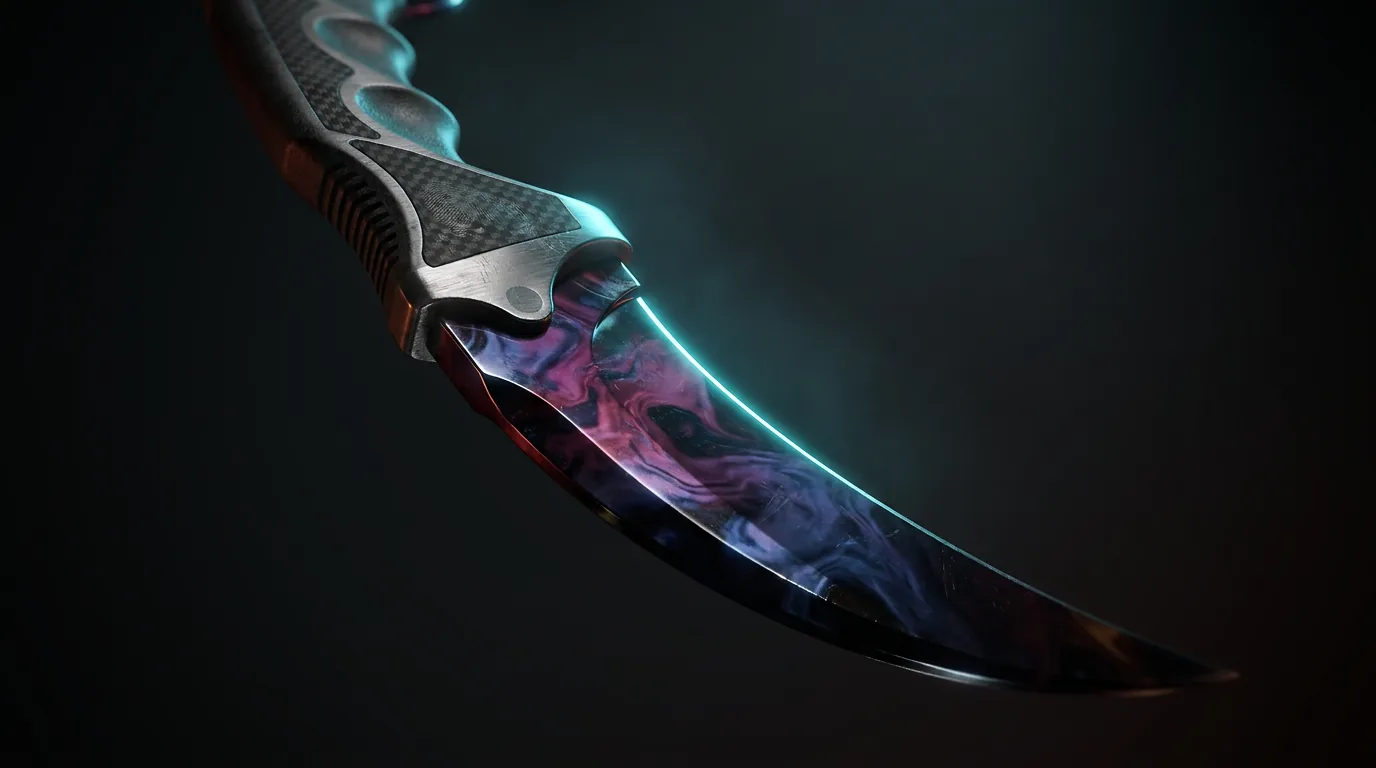
Doppler is the finish that made knife trading complicated. Under one name sit eight different products with different colours, different rarities and prices that are not remotely comparable. If you are buying a Doppler, the phase is the first thing to read and the seed is the second.
What Doppler actually is
Doppler arrived with the Chroma Case in 2015 and applies a marbled, oil-on-black effect to the blade — dark base metal with swirls of colour running through it. Gamma Doppler followed with the Gamma Case in 2016 as a green-led variant of the same idea. Both are knife-only finishes.
The key structural fact: a phase is not a paint seed. Each phase is a separate paint definition with its own colour set, which is why the game itself prints the phase on the item. You do not need a third-party tool to know whether you are looking at a Phase 2 or a Ruby — Valve tells you directly in the item’s name.
That makes Doppler unusual among pattern-sensitive finishes. The expensive variable is visible on the item, and the seed only fine-tunes what you already know you have.
The numbered phases
| Phase | Dominant colours | Character | Typical standing |
|---|---|---|---|
| Phase 1 | Black base with deep violet-blue and streaks of magenta and red | The darkest of the numbered phases; heavy, moody | Mid |
| Phase 2 | Bright pink and magenta cut with pale blue | The most colourful; unmistakable at a glance | Usually near the top |
| Phase 3 | Green and teal alongside blue and violet | The only numbered phase with real green in it | Usually the cheapest |
| Phase 4 | Black with strong, clean blue and minimal pink | The cleanest and most restrained | Usually at or near the top |
Phase 2 and Phase 4 generally lead the numbered phases, for opposite reasons — Phase 2 because it is the loudest and most recognisable, Phase 4 because it is the most restrained and reads as a serious knife rather than a colourful one. Phase 1 sits between them, and Phase 3 usually trails because the green reads as muddier than the other palettes to most buyers.
That ordering is a tendency, not a rule. It shifts between knife models and it shifts over time as tastes move, so check the current relationship on the specific model you are buying rather than assuming.
The rare phases
Sitting above the numbered phases are three special Doppler variants, produced at far lower rates.
Ruby replaces the marbling with a deep translucent red over black. Sapphire does the same in a rich blue. Black Pearl is the outlier: a near-black blade with a pearlescent swirl running through it, subtle in a way the other two are not.
Sapphire generally commands the most of the three, with Ruby behind it and Black Pearl behind that — though the ordering varies by knife model, and Black Pearl is scarce enough on some knives to invert it.
The critical thing about all three is that the seed matters enormously within them. Ruby and Sapphire both suffer from black patches: a seed that places the full red or blue across the visible face of the blade is a completely different item to one where a large black area sits in the middle of the playside. Traders talk about “full red” Rubies and “black spot” Rubies, and the gap between them is severe. Black Pearl varies even more — some seeds produce the clean dark pearl look people are paying for, others come out brownish or greenish and are noticeably less desirable.
Never buy a Ruby, Sapphire or Black Pearl from a stock preview image. The variance is the whole story.
Gamma Doppler and Emerald
Gamma Doppler runs Phase 1 through Phase 4 plus Emerald, its equivalent of the rare phases.
All four Gamma Doppler numbered phases are green-led, differing in how much black sits behind the green and whether the secondary tones lean yellow-green or purple. Phase 4 is generally the closest to a clean deep green and tends to lead the group; the earlier phases carry more black and more visible secondary colour.
Emerald is the rarest thing in the Doppler family and the most expensive finish outcome on most knives that have it. Like Ruby and Sapphire, it varies by seed — a full-coverage Emerald with a saturated green playside is a different product to one with black intruding on the visible face, and the market prices them accordingly.
Gamma Doppler was originally limited to a small set of knives and has been extended to more of the roster through later cases, so availability differs by model. Check that the combination you want actually exists before you go looking for it.
Within a phase, the seed still decides
Once you have fixed the phase, the paint seed determines where the colours land on the blade. This produces the second layer of Doppler grading.
On a Phase 2, buyers want the pink and magenta concentrated on the face of the blade you see during the inspect animation, rather than pushed onto the spine or the reverse. On a Phase 4, the prized outcome is the opposite: a clean sweep of blue across the playside with the black kept as a backdrop rather than as a patch in the middle. On a Phase 1, seeds that produce a mostly black playside with a single strong colour streak are widely admired.
Both faces get looked at, because the inspect animation rotates the blade. A knife with a spectacular playside and a dull backside is still a good buy, but the price difference between that and a knife that works from both angles is real.
None of this is displayed in-game. You need the inspect link and a pattern viewer, and you need to look at the specific item.
Wear on Doppler is a narrow question
Doppler and Gamma Doppler both have a tight maximum wear, which means they exist only in Factory New and Minimal Wear. There is no Field-Tested Doppler.
That compresses the entire wear dimension into two options, and the visual difference between them is modest — a Minimal Wear Doppler typically shows light scuffing along the blade spine and edge, leaving the marbling itself untouched. Factory New carries a premium, but it is a smaller premium than the phase difference and a much smaller one than the gap between a good and a bad seed within a rare phase.
The practical hierarchy on a Doppler is therefore: phase first, seed second, wear third. That is close to the reverse of how most people shop.
Reading a listing properly
A complete Doppler listing tells you four things: the knife model, the phase, the float, and the paint seed. If any of those is missing, you cannot price the item.
Watch for two common confusions. First, “Doppler” and “Gamma Doppler” are different finishes with different rare phases — Ruby, Sapphire and Black Pearl belong to Doppler; Emerald belongs to Gamma Doppler. Second, Doppler is not Marble Fade. Marble Fade is a separate finish graded on its own Fire and Ice standard, and it has no phases at all.
Also be aware that rendered previews use fixed studio lighting. A Phase 4 that looks brilliantly blue in a viewer will read much darker on a dim map, and a Phase 2 that looks searingly pink in a render is calmer in motion. If the colour is the reason you are buying, look at in-game footage of that phase before committing.
Practical takeaway
Read the phase off the item — the game gives it to you free — then treat it as the main price driver. Within the numbered phases, Phase 2 and Phase 4 usually lead and Phase 3 usually trails, but verify the current relationship on your specific knife model rather than assuming.
For Ruby, Sapphire, Black Pearl and Emerald, the seed does as much work as the phase name. Black patches on the playside are the failure mode, and they are common enough that buying without checking the actual item is a genuine risk. Get the inspect link, view it, and only then argue about float — because with Doppler locked to Factory New and Minimal Wear, wear is the least of your four variables.