


Guides
Discontinued Skins and Why They Climb in Value

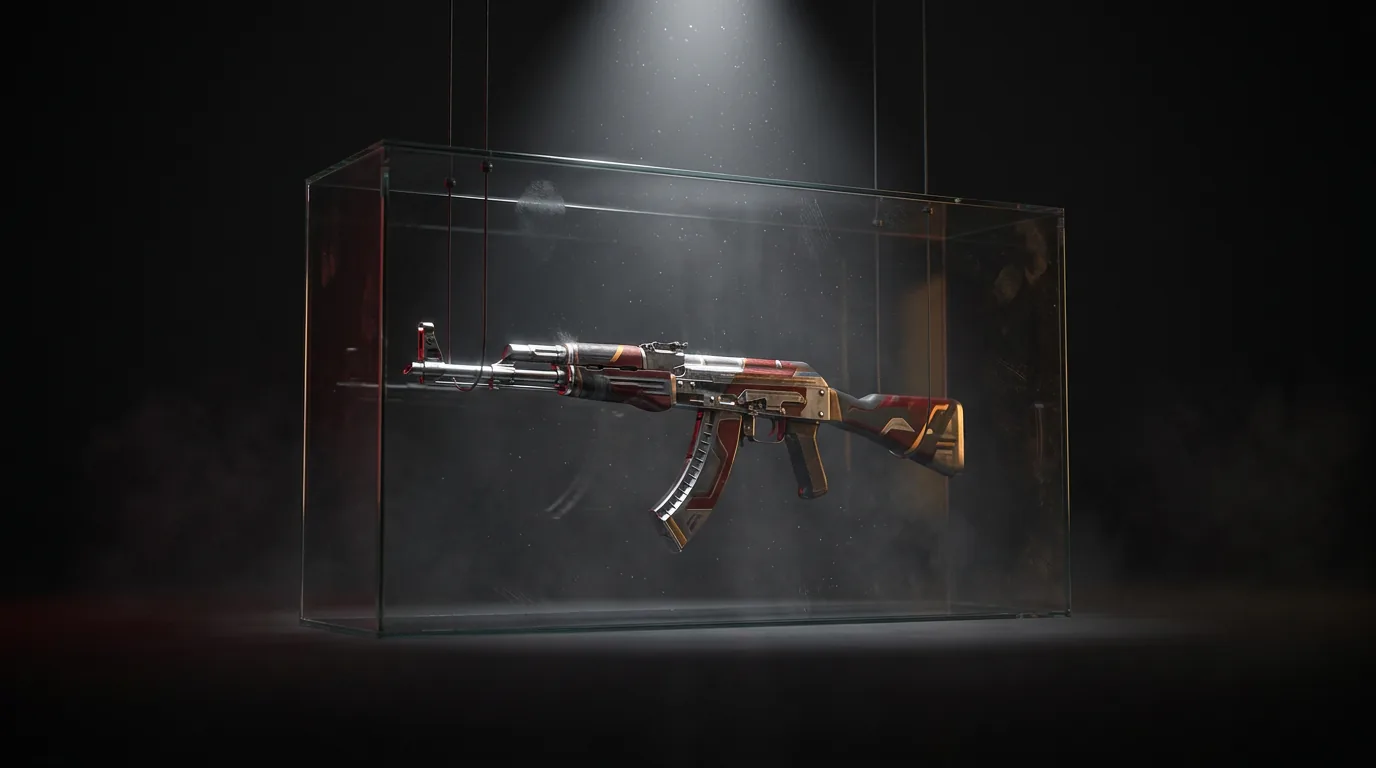
“Discontinued” gets thrown around loosely in skin trading, usually to justify a price. The word only means something if you can point to the exact mechanism that stopped supply — and in CS2 there are several distinct mechanisms, with very different consequences. Getting them straight is the difference between owning something structurally scarce and owning something that is merely old.
Four ways an item stops being produced
Rotation out of the drop pool. Valve maintains a small active set of weapon cases that can be earned through play. When a case rotates out, it moves to the rare drop pool, where it surfaces only occasionally. New supply does not stop entirely, but it slows to a trickle relative to the millions already in circulation. This is the softest form of discontinuation and the most common.
Collection retirement. Map collections drop only while their map is in the active rotation. Take the map out and the collection stops producing. The same applies to operation collections: when an operation ends, its exclusive drops end with it, permanently. Whatever exists is the entire supply, forever.
Event closure. Souvenir packages are generated only during a Major, for the duration of that Major. Sticker capsules tied to a tournament are sold only for a defined window. Once the event is over, the tap is welded shut — there is no rare drop pool equivalent, no occasional trickle. This is the hardest stop in the game.
Removal from production entirely. Occasionally Valve pulls a finish out of the game. The best-known case is the M4A4 Howl, whose artwork was found to have been plagiarised by the submitting artist. Valve removed the skin from the case and reclassified existing copies as Contraband — a rarity tier that exists for exactly this situation. Copies already owned stayed in inventories and remained tradable. No new ones can ever be created.
| Mechanism | New supply after the event | Examples of what it affects |
|---|---|---|
| Drop pool rotation | Trickle, via rare drop pool | Older weapon cases |
| Collection retirement | None | Retired map collections, operation collections |
| Event closure | None | Souvenir packages, tournament sticker capsules |
| Removal from production | None, and the item is reclassified | Contraband-tier items |
Fixed supply is only half the story
A capped supply on its own does not push a price anywhere. What actually moves discontinued items is that supply keeps falling while the population that wants them does not.
CS2 has an unusual number of mechanisms that permanently destroy items:
Case opening. Every case opened is consumed. For an out-of-production case, that is one fewer in existence, every single time, with no replacement.
Sticker application. Applying a sticker removes it from the market as a tradable item — it now lives on a specific weapon. Scraping it off destroys it outright. Old tournament capsules from the earliest Majors have been eroding this way for a decade, which is why the surviving stock of certain stickers is a small fraction of what was originally sold.
Trade-up contracts. Every contract consumes ten items to create one. Low-tier skins from retired collections get fed into contracts constantly, and that consumption is invisible in a way case opening is not.
Account attrition. Inventories go dormant, accounts get abandoned, some get banned. Items in those inventories are not destroyed but they are effectively removed from the tradable float, which has the same practical effect on availability.
Stack those together and an item that stopped being produced years ago is not sitting on a flat supply curve — it is sitting on a declining one. That is the actual engine behind long-run appreciation in this market.
Why some discontinued items go nowhere
Scarcity without demand is just an inventory problem. Plenty of genuinely finite CS2 items have gone essentially nowhere, and the reasons are consistent.
Nobody wants to look at it. A skin’s demand base is players who want it on their screen. An ugly finish on an unpopular weapon has a fixed, tiny audience. Making it rarer does not make it desirable; it just makes it illiquid.
The weapon is out of favour. Skins for guns that fell out of the competitive meta lose their everyday demand. Rifle and knife demand persists because those items are seen constantly. A skin for a weapon almost nobody buys in a round has demand that decays with attention.
The supply was never actually small. “Discontinued” items from a period when the game had a huge player base can still exist in enormous numbers. Age is not rarity. A case that dropped for a full year to millions of players is not scarce simply because it stopped dropping.
It is discontinued in name only. Items that stopped dropping but are still obtainable through some other route — a container that still drops, a collection still in a rotation — are not capped. Check the actual route, not the reputation.
How to check production status properly
Before you treat anything as finite, verify it rather than repeating what a listing told you.
Start with the item’s collection. Inspect it in-game and read the collection name, then work out whether that collection still has a live source. If it is a weapon case collection, the question is whether the case is still in the active drop pool. If it is a map collection, the question is whether the map is in the current rotation. If it is an operation collection, the operation has ended and the answer is settled.
For stickers and capsules, the question is whether the capsule is still sold in the in-game store. Tournament capsules are sold during and shortly after the event; once they leave the store, the only remaining supply is unopened capsules held by players and stickers already circulating.
For souvenir items, check which Major produced them. Every souvenir package is permanently tied to a specific event, and the supply was determined by how many drops that event generated.
Finally, look at the item’s own history rather than the category’s. A Contraband item and a common Mil-Spec from a retired map collection are both “discontinued”, and they have nothing else in common.
The risks nobody mentions
Discontinued items are the illiquid end of an already illiquid market. Three specific risks are worth naming.
Spread and time-to-sell. The rarer and more expensive an item, the fewer buyers exist at any given moment. Selling can take weeks and the gap between the price you see quoted and the price you can actually achieve is real. Paper value and realisable value diverge sharply at the top end.
Policy risk. Valve controls everything. Drop pools can be adjusted, containers can be reintroduced, trading rules can change, and there is no consultation. Nothing in this market is contractual — it is all at the discretion of the publisher.
Concentration. Putting a large share of an inventory into one rare item concentrates every one of these risks into a single position that you cannot partially exit. Ten mid-tier items can be sold one at a time. One expensive item cannot.
And the obvious one: past appreciation is a description of what happened, not a forecast. The supply mechanics are real and they are structural, but they only produce value while CS2 has an engaged player base buying skins. That is the underlying bet.
Practical takeaway
Ask one question of anything sold to you as discontinued: what specific mechanism stopped the supply, and is it a trickle or a hard stop? Rotation out of the drop pool slows production. Event closure and production removal end it.
Then ask the second question: what is destroying the existing supply, and who wants the item? Cases get opened, stickers get applied and scraped, low-tier skins get consumed by contracts — that ongoing attrition is what actually drives long-run prices, and it only matters if there is a demand base on the other side.
Finite plus wanted appreciates. Finite plus ignored just sits there. Verify the collection and the source yourself before you pay a scarcity premium, and size the position knowing you may need weeks, not minutes, to get back out.