


Guides
Case Hardened Blue Gems: Why Pattern Beats Wear

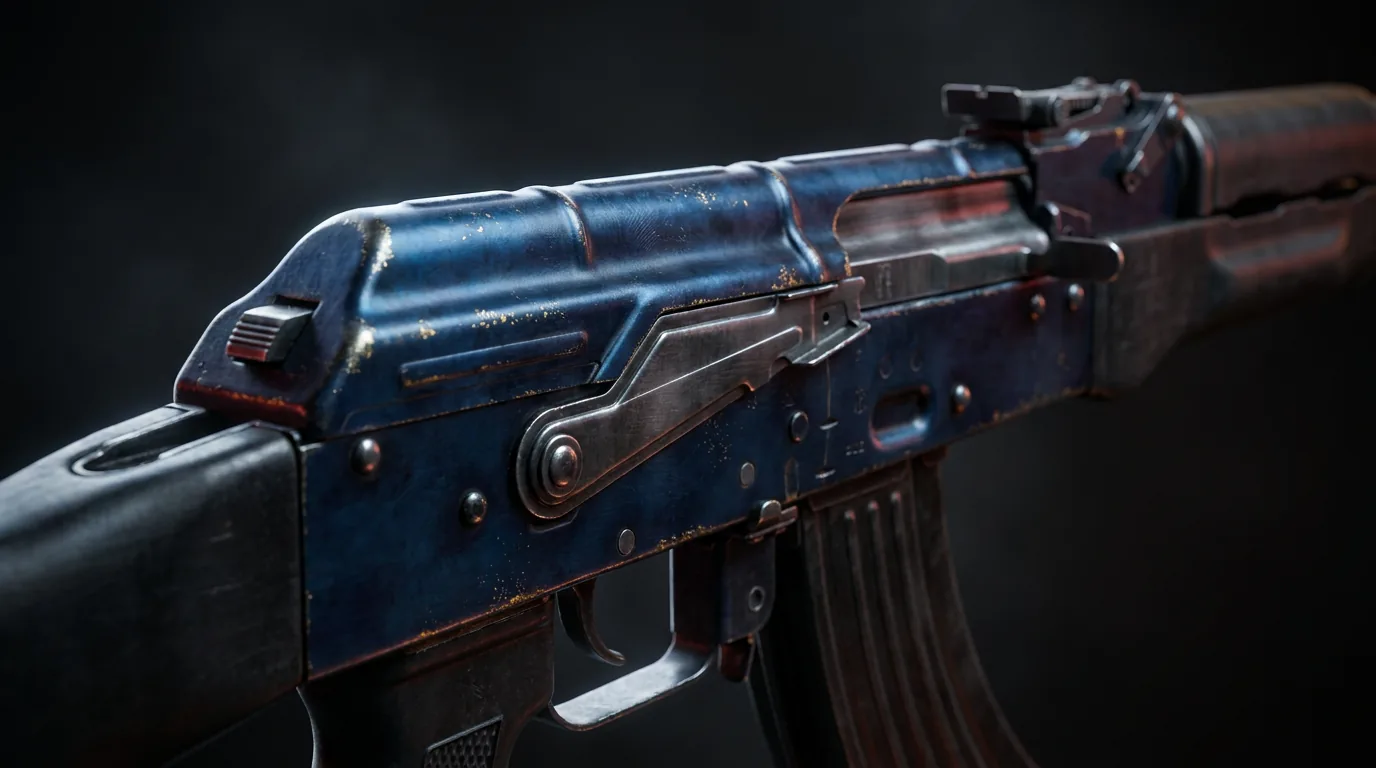
Case Hardened is the only finish in CS2 where the randomiser is the product. There is no artwork, no theme and no illustration — just a heat-treated metal texture and a number that decides where the blue lands. That number is worth more than every other attribute on the item combined, and it is why a battered Case Hardened can be worth many times a flawless one.
What Case Hardened actually is
The finish simulates the oil-slick colouring that appears on steel treated at high temperature: patches of deep blue bleeding into gold, purple and dull silver-grey, with no fixed boundaries. Valve built it as a texture much larger than the weapon’s UV layout, and the item’s paint seed selects which region of that texture gets stretched across the model.
Because the texture is not designed around the weapon’s geometry, the result is genuinely random. One seed puts a solid field of blue across the receiver; the next puts gold on the receiver and buries the blue under the handguard where nobody will ever see it. There is no artistic intent to any individual outcome, which is precisely why collectors treat it as a lottery with 1001 tickets.
Case Hardened exists on the AK-47, the Five-SeveN and the MAC-10, on nearly every knife in the game, and on Hydra Gloves. Each of those models has its own geometry, so a seed that produces a spectacular AK produces something completely different on a Karambit. The tier lists are per-weapon, always.
Playside is the only side that counts
The single most important concept in Case Hardened grading is the playside: the face of the item that you actually see.
On the AK-47, that is the side of the receiver, dust cover and magazine that faces you in the first-person view. The other side exists, and collectors will note it, but it is not what you look at while playing and it is not what carries the price. On knives, the playside is the face of the blade presented during the idle and inspect animations.
This is why blue coverage is graded by surface, not by volume. A seed with an enormous amount of blue distributed across the underside and the far face is worth a fraction of a seed with the same total blue concentrated on the one visible panel. Traders talk about “blue playside”, “blue backside” and, for the small number of seeds that manage both, “double-sided” — which is the top of the market on every weapon it applies to.
How grading works
Collector communities grade Case Hardened seeds into rough tiers based on how much of the playside is covered in unbroken blue, how saturated that blue is, and whether gold or grey interrupts it. The tier systems are unofficial, maintained by collectors, and they do not always agree with each other.
| Grade | What you see on the playside | How it behaves in the market |
|---|---|---|
| Top tier / blue gem | Near-complete blue coverage, minimal gold or grey intrusion | Priced individually, sold privately, no meaningful comparables |
| High tier | Dominant blue with visible gold or grey at the edges | Strong premium, small but real buyer pool |
| Semi-gem | Roughly half blue on the visible face | Where most pattern-aware trading actually happens |
| Mixed | Patchy blue, gold and grey in equal measure | Modest premium over base at best |
| Base | Little or no blue on the playside | Trades as an ordinary Case Hardened |
| Gold gem | Near-complete gold coverage | Collected in its own right, particularly on knives |
Two reference seeds anchor the whole conversation. On the AK-47, pattern 661 is the benchmark everyone compares against — it is the seed people mean when they say “the blue gem AK”. On the Karambit, pattern 387 plays the same role. Everything else on either weapon is positioned relative to those.
Why wear is the secondary variable
Float on a Case Hardened does not move the patina. The blue is exactly where the seed put it whether the item is Factory New or Battle-Scarred. What float does is layer a wear texture on top: scratches along the raised edges, scuffing on the receiver, and a general desaturation as the value climbs.
That is a fundamentally different relationship to the one you get on a custom paint job. On an Asiimov, wear damages the artwork. On a Case Hardened, wear ages a pattern that is still fully intact underneath.
The result is an inversion of the normal hierarchy. A Battle-Scarred top-tier seed remains a top-tier seed — visibly worn, but still the pattern collectors are hunting. A Factory New base-pattern Case Hardened is a clean gun with nothing special about it. In practically every case, the worn gem is the more valuable item, and by a wide margin.
But wear is not irrelevant
It would be a mistake to read that as “ignore float”. Within a given seed, wear does real work.
The wear overlay mutes the blue. At high floats the saturation drops noticeably, the edges of the colour fields get chewed up by scratches, and the effect that makes a gem worth chasing is partly diluted. A Factory New blue gem and a Battle-Scarred blue gem of the same seed are not close in value — the FN commands a very large premium — but both sit far above a Factory New of a poor seed.
There is a second dynamic on the AK specifically. Low-float Case Hardened AKs are scarce independent of pattern, which creates two overlapping markets: float buyers who want a clean receiver and do not care about the seed, and pattern buyers who want the seed and will accept whatever wear comes with it. Items that satisfy both are rare enough to be treated as one-offs.
The clean way to hold both ideas at once: pattern decides which market your item belongs to, and wear decides where you sit within it.
Gold gems and the inverse hunt
The same randomiser that produces blue produces gold, and on knives especially there is a parallel collector market for seeds that deliver near-complete gold coverage. Gold gems are visually striking in a completely different way — warm, metallic and much more subtle in motion — and they have a smaller but committed following.
Gold gems generally trade below equivalent blue gems on the same model, but the gap is narrower than most people assume, and on some knives a top gold seed is harder to find than a mid-tier blue one.
Buying one without getting burned
Verify the seed on the actual item. Ask for the inspect link and read it yourself through a pattern tool. A screenshot proves nothing — it can be of a different item entirely, and rendered previews use lighting that flatters the finish.
Understand which tier list you are being quoted from. Because grading is community-maintained, a seller can honestly describe an item as “tier 2” using a generous list while a stricter list places it several grades lower. Ask which standard, then check it against a second source.
Look at both faces before you decide. Plenty of seeds marketed on the strength of one panel fall apart the moment the weapon is viewed from any other angle, and if you are buying to look at rather than to hold, that matters.
Be realistic about liquidity. The number of people who both understand Case Hardened grading and are actively shopping for a specific tier at any given moment is small. Gems are slow to sell, they are usually sold privately, and the spread between what you pay and what you can realistically get back is wider than on liquid, pattern-neutral skins.
Practical takeaway
On Case Hardened, buy the pattern first. The seed is permanent, it is what the collector market prices, and no amount of float will make a poor seed interesting. Then optimise wear within that seed as far as your budget allows, because the wear overlay does mute the blue even though it cannot move it.
Verify everything through the item’s own inspect link, know which grading standard you are being sold against, and go in expecting a narrow, slow-moving market on the way back out. Case Hardened rewards patience and punishes anyone who buys on a description rather than on the number.