


Guides
How CS2 Collections and Cases Actually Work

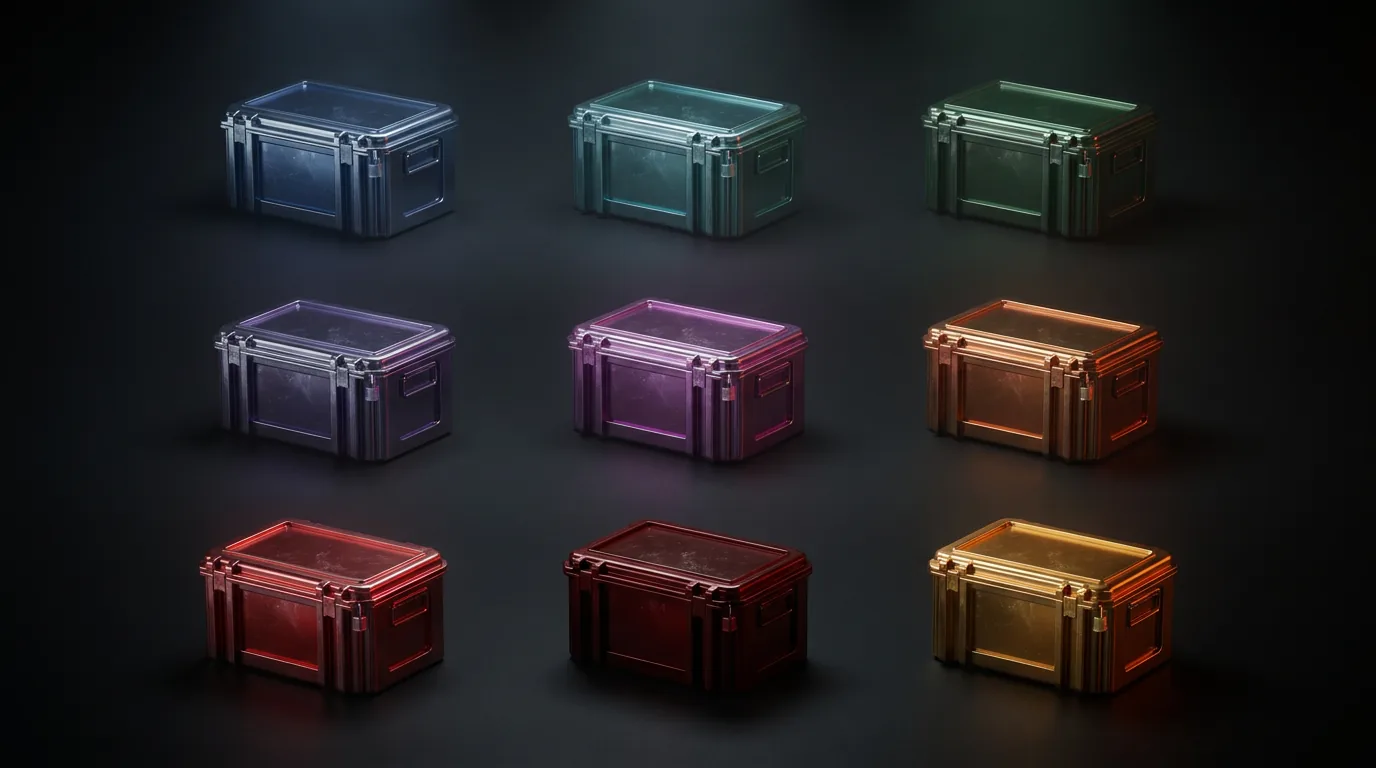
Most players use “case” and “collection” as if they mean the same thing. They do not, and the difference shows up the moment you try to run a trade-up, price a souvenir item, or work out why one skin keeps getting cheaper while another quietly climbs. Here is the actual structure.
Collections versus containers
A collection is a named set of skins that were designed and released together. Every skin in the game belongs to exactly one, and you can see which by inspecting the item — the description line reads “The [name] Collection”.
A container is a delivery mechanism. Weapon cases, souvenir packages, sticker capsules, patch packs and music kit boxes are all containers. They are how items get into circulation.
The confusion comes from weapon cases, because a weapon case and its collection share a name and contain the same items. The Kilowatt Case delivers The Kilowatt Collection. That one-to-one mapping is not universal, though. Plenty of collections have no case at all — the map collections tied to Dust II, Mirage, Overpass and the rest were never packed into a container. They dropped directly to players who ranked up while those maps were in the active pool.
That distinction is why the two words matter. Collections determine trade-up behaviour and pricing cohorts. Containers determine supply.
The rarity ladder
Every skin sits on a rarity tier, colour-coded in your inventory:
Consumer Grade (white), Industrial Grade (light blue), Mil-Spec (blue), Restricted (purple), Classified (pink), Covert (red), and then Contraband — a tier that exists only for items Valve pulled from production entirely. Knives and gloves sit outside this ladder as “Exceedingly Rare Special Items”, the gold tier.
Weapon cases never contain white or light-blue items. They start at Mil-Spec and run up to Covert, plus the rare special item. Map and mission collections that drop directly in-game do include the lower grades, which is why the cheapest skins in CS2 are almost all from non-case collections.
The ladder is not just decoration. It determines what a skin can be turned into by a trade-up contract, and it determines the relative frequency of each item when a case is opened.
| Tier | Colour | Found in weapon cases | Trade-up input | Trade-up output |
|---|---|---|---|---|
| Consumer | White | No | Yes | No |
| Industrial | Light blue | No | Yes | Yes |
| Mil-Spec | Blue | Yes | Yes | Yes |
| Restricted | Purple | Yes | Yes | Yes |
| Classified | Pink | Yes | Yes | Yes |
| Covert | Red | Yes | No | Yes |
| Special item (knife/glove) | Gold | Yes, as the rare drop | No | No |
| Contraband | Orange-red | No longer produced | No | No |
The single most misunderstood row is the last two. You cannot trade up into a knife, and you cannot trade a Covert into anything. Covert is the ceiling.
How a case opening resolves
When a case is opened, the game picks a rarity tier first, then picks an item within that tier, then rolls the item’s condition and pattern.
The tier weighting follows a consistent structure across weapon cases: each step up the ladder is roughly five times less likely than the step below it, with the special item tier sitting below Covert. The result is that the overwhelming majority of openings return Mil-Spec items, and the gold tier is a fraction of a percent.
Condition is rolled as a float value drawn from within the skin’s own defined range. Every finish has a minimum and maximum float, and those bounds vary skin by skin. A finish with a minimum float above 0.07 can never generate as Factory New, no matter how lucky you get. The condition brackets are fixed:
| Condition | Float range |
|---|---|
| Factory New | 0.00 – 0.07 |
| Minimal Wear | 0.07 – 0.15 |
| Field-Tested | 0.15 – 0.38 |
| Well-Worn | 0.38 – 0.45 |
| Battle-Scarred | 0.45 – 1.00 |
On top of that, cases that support StatTrak roll it independently — roughly one opening in ten produces a StatTrak version of whatever item you got, including knives.
Keys
Every weapon case needs its matching key. Keys are bought from the in-game store at a fixed price set by Valve, and since October 2019 newly purchased keys cannot be traded or sold on the Steam Community Market. They are permanently bound to the account that bought them. A small population of pre-2019 keys still circulates as a tradable legacy item, but for practical purposes: if you want to open a case, you buy the key, and that money is spent.
Not every container needs a key. Souvenir packages, sticker capsules and several operation containers open for free.
Souvenir packages are a different animal
Souvenir packages are generated during Valve-sponsored Majors and handed out to viewers watching in-game or through linked drops. They are not weapon cases and they do not behave like them.
A souvenir package contains one item from the relevant map collection, with stickers of the two competing teams, individual players and the match MVP applied to it. There is no knife tier. There is no StatTrak. The rarity distribution is drawn from the collection, so most packages return something from the bottom of the ladder.
The consequence is that souvenir item pricing is driven by three variables stacked on top of each other: which skin came out, what condition it rolled, and which player signatures ended up on it. A common skin carrying a legendary player’s sticker from a famous tournament can be worth far more than a rare skin from a forgettable event. If you are valuing souvenir items by skin name alone, you are missing most of the picture.
Souvenir items also cannot be used in trade-up contracts, and their supply is permanently capped the moment a Major ends.
Drop pools and why they rotate
Cases do not drop forever. Valve maintains an active drop pool — a small set of recent cases that can be awarded through gameplay — and older cases are rotated out into what players call the rare drop pool, where they appear only occasionally.
In CS2, you earn drops by playing and accumulating XP. When you hit the threshold, you get a care package and choose one item from a small selection. What can appear in that selection depends on the current drop pool, and Valve adjusts it with updates.
This rotation is the single biggest structural force in the case market. While a case is in the active pool, hundreds of thousands of new copies enter circulation every week and the price stays flat or drifts down. Once it rotates out, the tap closes. Supply stops growing, and every case that gets opened is permanently removed from the pool. Finite supply plus continuous destruction is a one-way ratchet, and it is why older cases behave so differently from current ones.
Map collections work the same way. When a map leaves the active duty pool, its collection generally stops dropping, and the existing supply becomes the whole supply.
Which cases contain gloves
Most weapon cases put knives in the gold tier. A small number put gloves there instead — the Glove Case, Clutch Case, Operation Hydra Case, Operation Broken Fang Case and Snakebite Case among them. Cases with gloves have no knife tier at all, and vice versa. If you are opening with a specific outcome in mind, check which pool the case draws from before you buy the key.
Knife finishes are also grouped. A given case does not offer every knife finish in the game; it offers a defined set of blade types paired with a defined set of finishes, which is why certain knife-and-finish combinations only exist from certain cases.
Practical takeaway
Treat collection and container as separate facts about an item. The collection tells you what the skin can become in a trade-up and which other skins it is priced against. The container tells you how it entered the world and, crucially, whether more of it is still being produced.
Before buying anything with an eye on holding it, check three things: is the source container still in the active drop pool, does the skin have a float range that permits the condition you want, and is the item souvenir, StatTrak or plain — because those are three separate markets wearing the same name. Get those right and most of the confusion around CS2 pricing disappears.