


Guides
Marble Fade and Its Rare Variants

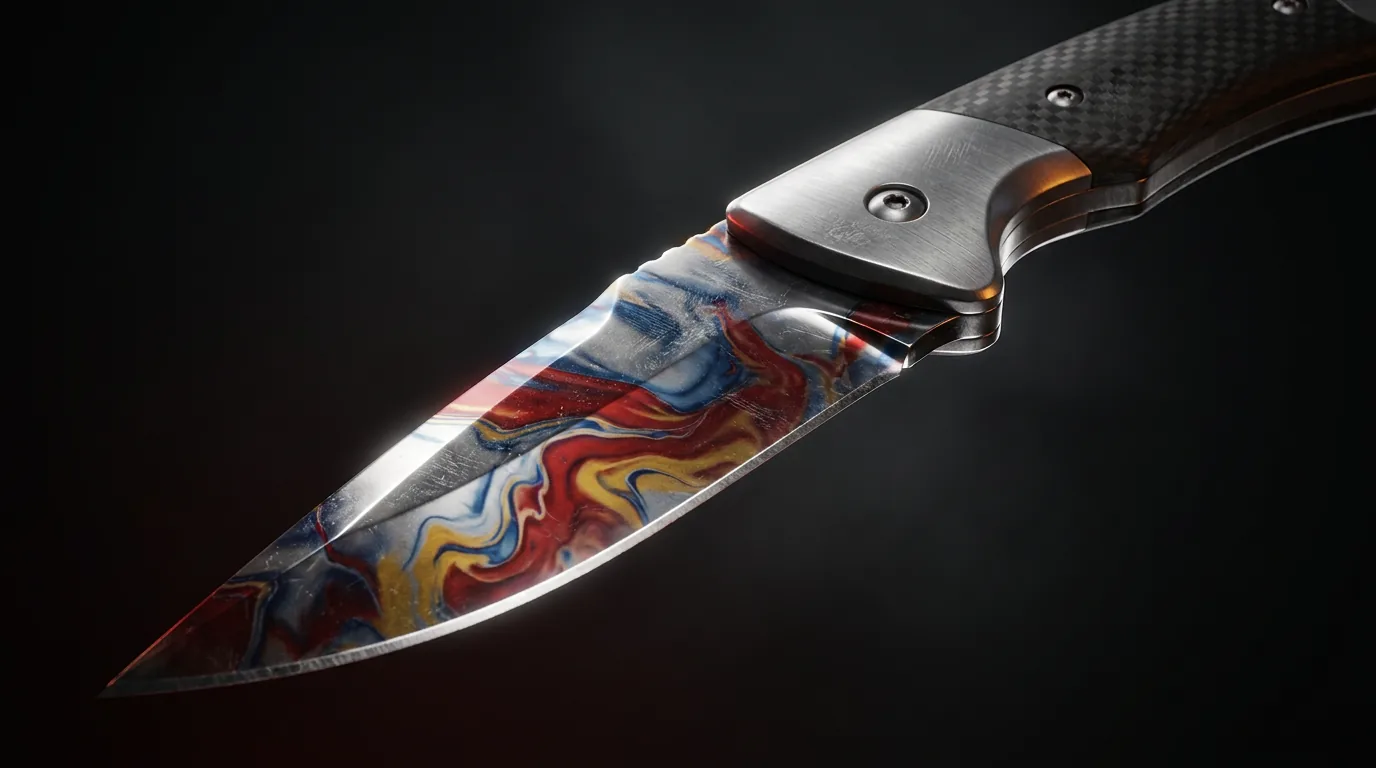
Marble Fade is one of the few CS2 finishes where two identical items — same name, same wear, same everything on paper — can be worth wildly different amounts. The difference lives in a single hidden number. If you trade knives and you do not understand pattern index, Marble Fade is where that gap will cost you.
What Marble Fade actually is
Marble Fade is a knife finish that arrived with the Chroma Case line, alongside Doppler, Tiger Tooth, Damascus Steel, Ultraviolet and Rust Coat. It renders the blade as a swirl of anodised colour — red, blue and yellow bleeding into each other like heat marks on steel. Unlike a painted finish, there is no artwork or logo to align, so the entire visual identity of the item comes from how those three colours happen to land on the blade.
It has since been applied to most knife types Valve has added, including the newer models introduced with later cases. That means “Marble Fade” is not one item, it is a finish shared across a whole family of knives, and the way the pattern reads changes considerably depending on the blade shape it is stretched over.
Wear barely matters, and that is unusual
Marble Fade only exists in Factory New and Minimal Wear. The finish’s float range tops out low enough that Field-Tested and below are impossible. Minimal Wear examples occupy a very narrow band at the top of that range.
Practically, this means wear is almost cosmetic trivia here. The anodised look does not fade or scuff the way a painted finish does — a Minimal Wear Marble Fade shows some scratching on the flat of the blade and nothing more. The price gap between FN and MW exists mostly because Factory New is the default expectation on a high-tier knife, not because the item looks meaningfully worse. If you are buying for looks rather than resale, MW is one of the more sensible discounts in the game.
Pattern index: the number that sets the price
Every skin instance is generated with a pattern index (also called the paint seed), a value drawn from a range of roughly a thousand possibilities. For most weapon finishes, the pattern index shifts the texture slightly and nobody cares. For Marble Fade, it determines exactly where red, blue and yellow sit on the blade — and that is the whole item.
Two Factory New Marble Fade Karambits with different seeds can look nothing alike. One might be a muddy wash of yellow across the playside. Another might be a clean split of red and blue at the tip. Steam and most listings show you the name and the wear; they do not show you the seed unless you look at the inspect link or the screenshot. This is why Marble Fade is bought on the picture, never on the title.
Playside and backside
Knives in CS2 have a display side — the side you see in the default inspect view and the side visible in-game most of the time. Pattern grading is done on that playside. A knife can carry a genuinely spectacular pattern on the reverse and be worth nothing extra, because nobody will ever see it in a match.
When you evaluate a listing, make sure the screenshot you are judging is the playside. A seller showing you only one angle of a Marble Fade is either careless or hoping you do not check.
The named variants
Because Valve does not label Marble Fade patterns the way it labels Doppler phases, the naming is entirely community-driven. Three descriptions dominate the conversation.
Fire and Ice is the headline pattern. On the playside, the blade shows alternating red and blue sections meeting cleanly at the tips, with the yellow pushed out of the way. The visual effect is a knife that looks like it has been half-quenched — hot on one side, frozen on the other. Genuine Fire and Ice seeds are a small fraction of the total, and the community grades them further by how many clean red-blue transitions appear along the edge and how sharply defined they are.
Fake Fire and Ice covers everything that looks close but fails on inspection. The usual tells are yellow intruding between the red and blue sections, breaking the contrast, or the strong pattern sitting on the backside while the playside is ordinary. These sell for far less than the real thing, and they are the most common trap for buyers who recognise the shape of the pattern but not the criteria.
Tricolour describes patterns where all three colours are present in balanced, distinct bands rather than blended. Less valuable than Fire and Ice, but visually striking and generally cheaper than its looks suggest — a reasonable target if you want something distinctive without paying the top-tier premium.
How grading tiers work
For the most heavily traded knife types, particularly the Karambit and M9 Bayonet, the community maintains ranked lists of Fire and Ice seeds. These are usually described as “1st max”, “2nd max”, “3rd max” and so on, referring to how completely the pattern satisfies the criteria. A 1st max is the cleanest available expression of the pattern on that blade; lower tiers show progressively more yellow bleed or weaker definition.
Two things to keep in mind. First, these rankings are conventions, not game mechanics — Valve has never published a Marble Fade tier list, and the grading criteria are set by collectors. Second, the rankings are blade-specific. A seed that produces a top-tier pattern on a Karambit produces something entirely different on a Butterfly Knife, because the pattern is mapped onto a different shape. Never carry a seed number across knife types.
How Marble Fade compares to other pattern-driven finishes
| Finish | What varies | How it is described | Where the value sits |
|---|---|---|---|
| Marble Fade | Placement of red, blue and yellow | Community grading (Fire and Ice, tricolour, tiers) | A narrow set of seeds; everything else is baseline |
| Doppler | Which colour phase generates | Valve-assigned phases plus rare gems | The rare gems; phases carry a smaller spread |
| Fade | How far the gradient runs up the blade | Percentage, calculated from the pattern | Higher percentages, with a steady curve rather than a cliff |
| Case Hardened | Amount and placement of blue | Community grading of blue coverage | Extreme blue-heavy patterns |
The key structural difference: Doppler has phases baked into the item name, so the market prices them automatically. Marble Fade does not. The item is called “Marble Fade” whether it is the best seed in the game or the worst, which means the pricing gap has to be discovered by the buyer. That inefficiency is exactly why the finish rewards people who do their homework and punishes people who do not.
Buying and selling without getting caught out
Verify the pattern before you commit. The inspect link renders the actual item, not a stock image, so open it and look at the playside yourself rather than trusting a cropped screenshot. If a listing has no inspect link and no clear playside image, treat the pattern as ordinary and price it accordingly.
Be sceptical of pattern claims in listing titles. “Fire and Ice” written by a seller is marketing, not a grade. Check the seed against community references for that specific knife model, and check that the criteria are actually met — clean red-to-blue meeting points, no yellow wedged between them, on the correct side.
Understand what you are paying the premium for. A graded Fire and Ice is not a better knife to play with; it is a collector item with a thin, slow market. The stronger the pattern, the fewer buyers exist at that price, and the longer it takes to sell. Ordinary-seed Marble Fades move quickly and predictably. That liquidity difference matters more than most people account for when they buy a top-tier pattern expecting to flip it.
Finally, remember that StatTrak sits on top of all of this as a separate multiplier, and that a StatTrak Marble Fade with a strong pattern combines two thin markets into one very thin market.
Practical takeaway
Marble Fade is a finish where the name on the item tells you almost nothing. The pattern index decides the value, the playside is the only side that counts, and the difference between a genuine Fire and Ice and a convincing fake comes down to whether yellow interrupts the red-blue transition. Buy on the rendered item, not the listing title. Accept Minimal Wear when you want the look for less, because the wear genuinely does not show much on an anodised blade. And if you are buying a graded pattern, go in knowing you are entering a slow, narrow market — that is the trade-off you are accepting in exchange for owning something most players will never see in a server.