


Guides
Understanding CS2 Skin Rarity Tiers

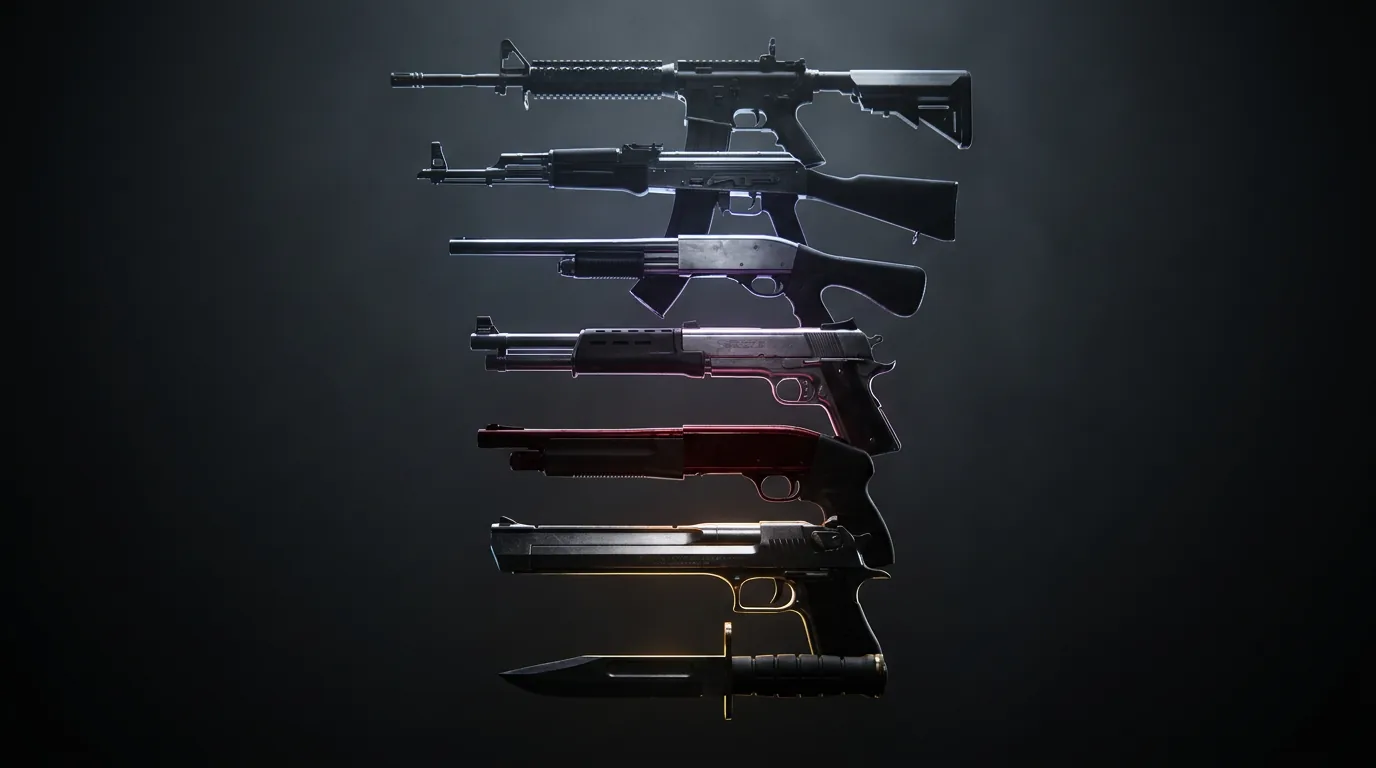
Rarity in CS2 is a colour-coded ladder that determines how often an item drops, not how much it’s worth. Those two things overlap often enough that people conflate them, and then get confused when a blue skin outprices a pink one. Here’s how the ladder is actually built.
The weapon skin ladder
Every weapon finish sits in exactly one rarity tier, fixed by Valve when the skin is released. The tier never changes and it applies regardless of wear, StatTrak status or how much the item trades for.
| Tier | Colour | Where it comes from |
|---|---|---|
| Consumer Grade | White / grey | Map collections, older non-case collections |
| Industrial Grade | Light blue | Map collections, older non-case collections |
| Mil-Spec Grade | Blue | The most common tier inside weapon cases |
| Restricted | Purple | Cases and collections |
| Classified | Pink | Cases and collections |
| Covert | Red | The top skin tier in cases and collections |
| Contraband | Amber | A single discontinued item |
| Extraordinary | Gold | Knives and gloves — the “rare special item” slot |
Reading the colours is a fast skill to build, because the item name border in your inventory, on the buy menu and in every listing you’ll ever see uses this exact palette. Blue means Mil-Spec, purple means Restricted, pink means Classified, red means Covert. Learn that and you can triage a listing at a glance.
Where the two bottom tiers live
Consumer Grade and Industrial Grade skins essentially never appear in modern weapon cases. Cases start at Mil-Spec. The white and light-blue tiers come from collections — the map-based sets like the Dust II or Mirage collections, and older non-case sets — which drop as ordinary in-game rewards or arrive as Souvenir items from Majors.
That’s why a lot of players never consciously see them. They’re the cheapest items in the game individually, and their main economic role is as trade-up fodder.
The gold tier
Knives and gloves don’t sit on the same ladder as weapon finishes. They’re classified as Extraordinary and displayed in gold, and inside a case they occupy a separate slot described as an exceedingly rare special item rather than being lumped in with the Covert skins.
Practically, gold is a category rather than a rung. A knife and a pair of gloves share the tier, but they’re not interchangeable in value, and within knives the spread between the cheapest finish on an unpopular blade and a top-tier pattern on a sought-after one is enormous. The gold border tells you the item came out of the rare slot. It tells you nothing else.
Contraband: a tier with one occupant
Contraband exists because of a single incident. The M4A4 | Howl was withdrawn after a copyright dispute over its artwork, the design was replaced in-game, and the existing copies were reclassified into a tier created specifically to mark them. No more were ever produced. The Howling Dawn sticker, which used the same artwork, carries the same designation.
Contraband is therefore the only genuinely fixed-supply rarity tier in the game — supply can only shrink, never grow. It’s an outlier and not a category you’ll encounter in normal trading, but it’s the cleanest illustration in CS2 of the difference between rarity as a label and scarcity as an economic fact.
What the odds actually are
Valve publishes the drop rates for weapon cases, and they’re steeply weighted toward the bottom of the ladder. Blue Mil-Spec items make up the overwhelming majority of case openings, purple Restricted items a small fraction of that, and each subsequent tier is roughly a fifth as likely as the one below it. The rare special item slot — knives and gloves — is the least likely outcome of all, sitting well under one percent.
The published figures are:
| Outcome | Chance per case opening |
|---|---|
| Mil-Spec Grade (blue) | 79.92% |
| Restricted (purple) | 15.98% |
| Classified (pink) | 3.20% |
| Covert (red) | 0.64% |
| Rare special item (gold) | 0.26% |
Separately, any weapon skin pulled from a case that supports StatTrak has a 10% chance of coming out as a StatTrak version. That roll is independent of rarity, so a StatTrak Covert is roughly a tenth as likely as a normal Covert.
Two things follow. First, the rarity ladder is a probability ladder, and the numbers get brutal fast — the gap between pink and red is bigger than most people intuitively feel when they’re opening cases. Second, because each tier contains multiple different skins, the odds of any specific item are lower still than the tier odds suggest. A case with four Covert skins splits that 0.64% four ways before wear and StatTrak are even considered.
Rarity outside weapon skins
The same concept is reused with different vocabulary across other item types, which is a frequent source of confusion when reading listings.
Stickers run High Grade, Remarkable, Exotic and Extraordinary. Patches use the same set. Graffiti adds Base Grade at the bottom of that list. Agents have their own four rungs — Distinguished, Exceptional, Superior and Master — and cases themselves are Base Grade items.
The important point is that these ladders are parallel, not equivalent. An Extraordinary sticker and an Extraordinary knife share a word and nothing else. When you’re valuing a weapon that has stickers applied, you’re looking at two independent rarity systems stacked on one item.
Where the ladder and the price list disagree
Rarity sets how often something enters the world. Price is set by how many people want it against how many copies exist and are actually for sale. Those diverge constantly, and understanding why is most of what separates a trader from a case-opener.
Old blue skins can beat new pink ones. A Mil-Spec skin from a discontinued collection that stopped generating supply years ago can be worth many times a Classified from a case that is still in active rotation. Supply stopped for one and didn’t for the other.
Weapon choice dominates. A Covert on a weapon almost nobody buys in a competitive round is worth a fraction of a Classified on an AK-47 or AWP. Demand tracks what players actually hold in their hands, and a small set of weapons carries most of the market.
Design beats tier. Some Restricted skins are simply better-looking than the Coverts in the same case, and the market prices aesthetics, not the border colour. A skin that reads well at a distance, works with common agent models and doesn’t clash with the map palette will find buyers regardless of tier.
Rarity is fixed, supply is not. Every case that’s still dropping is adding copies of its Coverts to the world every week. Every retired case has stopped. Two skins can share a tier and be on completely opposite supply trajectories.
Rarity and trade-up contracts
Rarity is also the mechanic that makes trade-ups work. A contract takes ten skins of the same rarity tier and returns one item from the tier directly above, drawn from the collections the inputs came from. That’s why the ladder matters operationally and not just cosmetically — Consumer feeds Industrial, Industrial feeds Mil-Spec, and so on up to Classified feeding Covert.
Covert is the ceiling. You cannot trade up into the gold tier, so no chain of contracts will ever produce a knife or gloves. Inputs must also match on StatTrak status, and Souvenir items are excluded entirely.
Practical takeaway
Learn the colours first: white, light blue, blue, purple, pink, red, with gold for the knife and glove slot and amber for the single Contraband item. That gets you reading listings quickly.
Then separate rarity from value in your head permanently. Rarity is a drop-rate label that Valve assigned once and never revisits. Value comes from whether the case still drops, whether people actually use that weapon, whether the design is good, and how many copies are sitting on the market right now. When a blue skin costs more than a pink one, nothing is broken — you’re just looking at supply and demand doing what a colour code was never designed to describe.