


Guides
Knife Skins Explained: Types, Finishes and What Drives Price

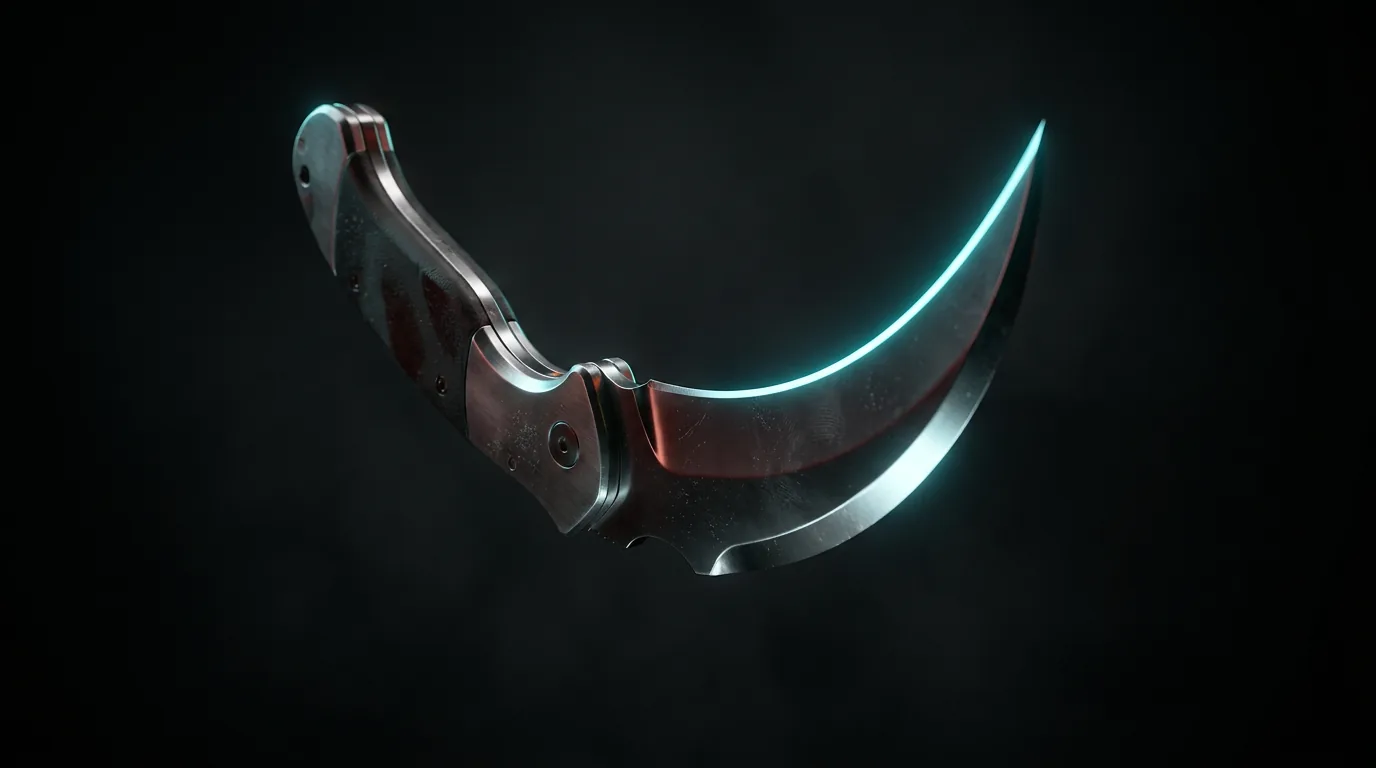
A knife is the single largest line item in most CS2 inventories, and the pricing logic behind it is less mysterious than it looks. Type, finish, wear and pattern each do a specific job, and they do it in a specific order. Learn that order and you stop overpaying for the wrong attribute.
How knives work in CS2
Knives sit in the Extraordinary rarity tier, shown gold and marked with a ★. They come from weapon cases only — every knife in the game was pulled from a case at some point, and Valve’s published odds put the rare special tier (knives and gloves together) well under one percent of case openings. There is no way to manufacture one: trade-up contracts cannot produce knives, and no drop system outside cases generates them.
Knives support StatTrak, which is generated at a much lower rate than the plain version. They do not have Souvenir variants. They accept name tags but not stickers, so unlike rifles there is no sticker layer to complicate valuation. That leaves four attributes doing all the work: which knife it is, which finish it wears, how worn it is, and what its paint seed produced.
The twenty knife types
The model matters more than most new traders expect. It sets the base price band before the finish is even considered, and it determines the inspect animation you will be looking at for years.
| Knife | Introduced with | Character | Typical price band |
|---|---|---|---|
| Karambit | Original 2013 set | Curved claw blade, finger ring, showpiece inspect | Premium |
| Butterfly Knife | Operation Breakout | Balisong with flip-open animations | Premium |
| M9 Bayonet | Original 2013 set | Long clip-point bayonet, aggressive silhouette | Premium |
| Talon Knife | Horizon Case | Karambit-style claw with a fuller, heavier blade | High |
| Skeleton Knife | Operation Shattered Web | Skeletonised handle, distinctive spin inspect | High |
| Bayonet | Original 2013 set | Classic military bayonet | Upper-mid |
| Stiletto Knife | Horizon Case | Slim switchblade, flick-open animation | Upper-mid |
| Flip Knife | Original 2013 set | Folding blade, quick flip inspect | Mid |
| Bowie Knife | Operation Wildfire | Broad heavy blade, slow deliberate animation | Mid |
| Huntsman Knife | Huntsman Weapon Case | Straight tactical blade | Mid |
| Falchion Knife | Falchion Case | Curved folding blade | Mid |
| Nomad Knife | Operation Shattered Web | Rugged blade with wrapped handle | Mid |
| Survival Knife | Operation Shattered Web | Serrated spine, utility styling | Mid |
| Paracord Knife | Operation Shattered Web | Cord-wrapped handle, compact blade | Mid |
| Ursus Knife | Horizon Case | Bayonet-like shape, cleaner lines | Mid |
| Classic Knife | Operation Shattered Web | Recreation of the original Counter-Strike knife | Mid |
| Kukri Knife | Kilowatt Case | Forward-curving heavy blade | Mid |
| Gut Knife | Original 2013 set | Hooked gut blade | Entry |
| Navaja Knife | Horizon Case | Small folding Spanish knife | Entry |
| Shadow Daggers | Shadow Case | Dual daggers, held one in each hand | Entry |
Price bands are relative and they move, but the ordering is remarkably stable. The Karambit and Butterfly have led the market for a decade because their inspect animations are the most theatrical in the game. The Shadow Daggers and Navaja anchor the bottom because they are visually small and their animations are unremarkable — which makes them the sensible entry point if you want a ★ in your inventory without a serious outlay.
The finish families
Finishes arrived in waves, and each wave has a recognisable palette.
The original finishes shipped with the first knives: Case Hardened, Fade, Crimson Web, Slaughter, Night, Blue Steel, Stained, Forest DDPAT, Boreal Forest, Safari Mesh, Urban Masked and Scorched. These are the cheapest finishes on most knives, with two enormous exceptions — Fade and Case Hardened, which are among the most valuable finishes in the game.
The Chroma finishes brought colour: Doppler, Marble Fade, Tiger Tooth, Damascus Steel, Ultraviolet and Rust Coat. Doppler and Marble Fade are the two that carry the modern knife market.
The Gamma finishes followed: Gamma Doppler, Lore, Autotronic, Black Laminate, Freehand and Bright Water. Gamma Doppler is the headline; Lore and Autotronic are the design-led picks.
Then there is Vanilla — a knife with no finish applied at all. It shows the plain steel model, carries no displayed wear condition, and trades as its own category. Vanilla knives are polarising: some collectors consider them the purest expression of the model, others find them unfinished. Their prices sit surprisingly high because the supply of plain knives is small relative to demand from people who want the shape rather than the paint.
Wear ranges are finish-dependent
This is the mechanic that trips up most first-time knife buyers. Wear tiers are not universally available.
Doppler, Gamma Doppler, Marble Fade, Fade, Tiger Tooth, Damascus Steel and Ultraviolet all have a tight maximum wear, which means they exist only in Factory New and Minimal Wear. There is no Field-Tested Fade Karambit. If you see a knife with one of these finishes, you are choosing between two conditions, not five, and the visible difference between them is modest — on a Doppler or a Fade, Minimal Wear typically shows only light edge wear on the blade spine.
Rust Coat runs the opposite way: it exists only in Well-Worn and Battle-Scarred, because a pristine rust finish would defeat the point.
The original and Gamma finish families generally span the full range. On these, wear does real visual work — a Battle-Scarred Crimson Web loses much of its web definition, and a Battle-Scarred Case Hardened desaturates noticeably.
The practical consequence is that “Minimal Wear” means very different things on different finishes. On a Fade it is close to indistinguishable from Factory New. On a Blue Steel it is a genuinely different item.
What drives price, in order
1. Knife type. This sets the band. A Doppler on a Karambit and the same Doppler on a Navaja are not in the same market.
2. Finish. Within a type, the finish determines where in the band you sit. Fade, Doppler, Gamma Doppler, Marble Fade and Case Hardened lead; the plain original finishes trail.
3. Wear. Within a finish, float moves you up or down — heavily on full-range finishes, lightly on the FN/MW-only ones.
4. Pattern. On most finishes this is a rounding error. On Case Hardened, Fade, Marble Fade, Doppler, Gamma Doppler and Crimson Web it can dominate everything above it.
5. StatTrak. A modifier, not a category. It adds most on knives people actually play with and least on pure collector pieces, and on some pattern-critical items a StatTrak tag actually narrows your buyer pool.
Where pattern overrides the order
Five finishes break the hierarchy badly enough to be worth memorising.
Case Hardened is decided by how much blue the seed places on the visible side. A worn blue gem beats a pristine ordinary seed by a wide margin.
Fade is graded by fade percentage, a value derived from the seed that describes how far the purple has travelled up the blade. Higher percentages carry a premium and 100% carries the largest one.
Marble Fade is graded on the arrangement of red, blue and yellow. The sought-after configuration is Fire and Ice, where red and blue meet on the visible face of the blade without yellow interrupting them.
Doppler and Gamma Doppler are split into named phases, each a separate paint definition, and within each phase the seed decides where the colours land on the blade.
Crimson Web and its relatives are graded by how many webs sit on the top of the blade where you can see them. Traders talk in web counts, and a maximum-web example trades far above a one-web version at the same float.
Buying a knife without regretting it
Look at the actual item, not the tier name. Inspect it in-game if you can, or at minimum check the float value and the paint seed rather than trusting the wear label.
Decide whether you want the animation or the finish. If the inspect animation is what you care about, buy the model first and take a cheaper finish on it. If the colour is what you care about, drop a tier on the model and put the money into the finish. Buying a mediocre finish on a mediocre model to hit a price point produces something you will want to replace within a month.
Be honest about pattern. If you are buying a Case Hardened, a Fade or a Marble Fade, you are buying into a market where the seed is the product. Going in without checking it means you will almost certainly pay a fair price for a below-average example and then discover the difference later.
Practical takeaway
Type sets the band, finish sets the position, wear moves you inside it, and pattern only matters on the handful of finishes where it matters enormously. Check which wear tiers your chosen finish even offers before you start comparing — half the finishes in the game do not have five conditions. And if the finish is Case Hardened, Fade, Marble Fade, Doppler or Crimson Web, learn the pattern grading before you spend, because on those five the seed is not a detail, it is the item.