


Guides
Factory New vs Minimal Wear: Is the Premium Worth It

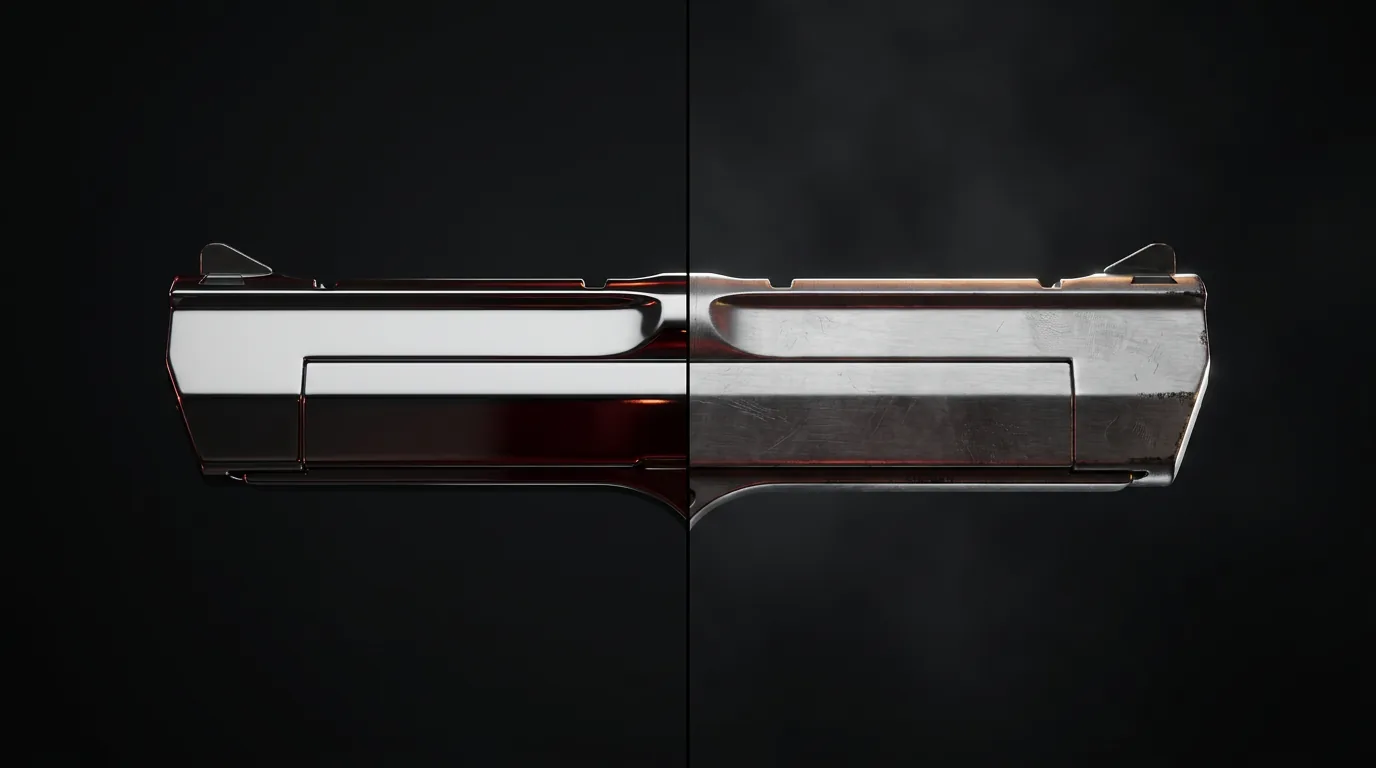
Factory New always costs more than Minimal Wear. Whether that gap buys you anything you can actually see is a completely different question, and on a lot of skins the honest answer is no. Working out which side of that line a specific skin falls on is one of the easiest ways to stop overpaying.
The two brackets, precisely
| Bracket | Float range | Width of the band |
|---|---|---|
| Factory New | 0.00 – 0.07 | 0.07 |
| Minimal Wear | 0.07 – 0.15 | 0.08 |
The two brackets are almost identical in width and they sit directly against each other. A skin at 0.0699 is Factory New. A skin at 0.0701 is Minimal Wear. Those two items are, in every meaningful visual sense, the same weapon — the wear algorithm doesn’t know a naming boundary exists. But they carry different labels, and the market prices labels.
That single fact is the whole opportunity here.
What actually changes between the two
Wear in CS2 works by revealing the underlying material through the paint, concentrated on the areas the artist marked as high-contact — edges, corners, the magazine well, the barrel, the parts of the model that would realistically get knocked about. As the float rises, those areas lose more paint and more of the base metal shows through.
Across the Factory New band, most skins show effectively nothing. Across Minimal Wear, you start to get fine scratching along edges and a slight break-up of the finish on raised surfaces. It is genuinely minimal — the bracket is named accurately. At the top end of Minimal Wear, approaching 0.15, some skins begin to look noticeably used.
CS2’s lighting model matters here too. The renderer picks up specular detail more aggressively than the old engine did, which means scratching on glossy and metallic finishes reads more clearly than players who came from CS:GO expect. Matte and heavily-textured finishes are affected far less.
Where the difference is obvious
The premium is easiest to justify on finishes with large areas of flat, uninterrupted colour, on high-gloss and chrome-style surfaces, and on gradients where any interruption breaks the effect. Anything where the appeal is the smoothness of the surface will be visibly compromised by even light scratching. Knife finishes built around polished metal and colour transitions fall squarely in this group, and so do gloves, where wear presents as fraying and dirt across a large soft surface rather than as small edge scratches.
Where it’s essentially invisible
Busy camouflage patterns, dark colourways, heavily-detailed artwork and anything with visible surface noise built into the texture will hide Minimal Wear scratching completely at any distance you’ll ever view the weapon in a match. On these skins, the honest visual difference between Factory New and a low Minimal Wear is nil, and the difference between Factory New and a mid Minimal Wear is something you have to hunt for in the inspect screen.
If you can’t reliably tell the two apart when you inspect them side by side, you are paying for a text label.
Why the premium varies so much between skins
The size of the Factory New premium is mostly a supply story, and you can reason about it directly from the skin’s own float range.
Because wear values spread across a skin’s permitted range, the proportion of copies landing in Factory New is simply the share of that range sitting below 0.07. A skin with the full 0.00–1.00 range only produces Factory New copies in the bottom sliver of its range. A skin capped at 0.00–0.25 produces them far more often.
| Skin’s own float range | Share of that range that is Factory New |
|---|---|
| 0.00 – 1.00 | Bottom 7% of the range |
| 0.00 – 0.50 | Bottom 14% |
| 0.00 – 0.25 | Bottom 28% |
| 0.00 – 0.08 | Roughly the bottom 88% |
The pattern is clear. On wide-range skins, Factory New is genuinely scarce and the premium reflects real rarity. On narrow-range skins — a lot of knife finishes sit here — Factory New is the default outcome and Minimal Wear is the unusual one. Some capped finishes barely reach past 0.07 at all, which makes their Minimal Wear versions both rare and visually near-identical to Factory New.
That last case is one of the most reliably underpriced situations in the game: a Minimal Wear knife at the very bottom of a tiny Minimal Wear window, sitting a few thousandths above a boundary nobody can see.
The bottom-of-bracket play
The general version of that idea applies everywhere. If you want the Factory New look without the Factory New label, buy Minimal Wear as close to 0.07 as you can find.
Sellers who list only the bracket name and not the float are, in effect, pricing every Minimal Wear copy the same — from 0.0701 to 0.1499. Those are not the same item. Filtering for the bottom of the band costs nothing but time and gets you a weapon that inspects like a Factory New at a Minimal Wear price.
The reverse trap is just as common. A Minimal Wear near 0.149 is at the far edge of the bracket and is closer in appearance to a clean Field-Tested than to a Factory New. If you’re paying near the top of the Minimal Wear price range for one of those, you’ve got the worst of both.
When Factory New is the right buy
There are solid reasons to take the premium.
Resale and liquidity. On popular skins, Factory New is the condition the largest pool of buyers is looking for, and it moves faster. If you expect to sell within a reasonable timeframe rather than hold indefinitely, the tighter spread and quicker sale can be worth more than the entry discount.
Skins where the finish is the point. Gradients, polished metals, colour transitions, anything mirror-like. If a scratch across the middle of the effect ruins the skin, buy the condition that doesn’t have one.
Collecting intent. If you’re assembling a set, holding for the long term, or you simply want the best available copy, that’s a legitimate reason and doesn’t need financial justification. Just don’t pretend it’s a value decision.
StatTrak and stickered builds. People who invest in a StatTrak version or apply expensive stickers generally want the underlying skin to be clean, and the market reflects that. A stickered Minimal Wear is a harder sell than a stickered Factory New.
When Minimal Wear wins
Minimal Wear is the better buy when the design hides wear, when Factory New supply is abundant enough that the premium is pure label tax, when the skin is capped low enough that the two brackets overlap visually, and — importantly — when Factory New is expensive enough to price you out of the skin you actually want.
That last one deserves emphasis. A Minimal Wear copy of a skin you love beats a Factory New copy of a skin you settled for. Condition is a modifier on the item, not the item.
The skins where the choice doesn’t exist
Not every finish supports both brackets. Skins with a minimum wear above 0.07 have no Factory New version at all, and skins with a minimum above 0.15 have neither — the cleanest examples in existence are Field-Tested. Others cap out so low that Minimal Wear barely exists.
Before you start comparing, confirm both conditions are actually obtainable for that finish. Plenty of newer traders spend an hour hunting a Factory New that was never possible.
Practical takeaway
Inspect before you decide. Pull up the same skin in both conditions and look at them properly — if you can’t tell which is which, the premium isn’t buying you anything.
Then check the skin’s own float range to understand whether Factory New is genuinely scarce for that finish or simply the common outcome. Buy Factory New when the surface is smooth, the design shows every mark, or you need liquidity for a future sale. Buy Minimal Wear — and specifically the bottom of Minimal Wear, as close to 0.07 as you can get — when the artwork hides scratching or when the label premium has run away from the visual difference. That single filter, applied consistently, saves more money over time than any other habit in skin buying.